
Video
Writing a Book – Two Simple Tips from Lessons in Leadershit
October 27, 2017 · 3 min read
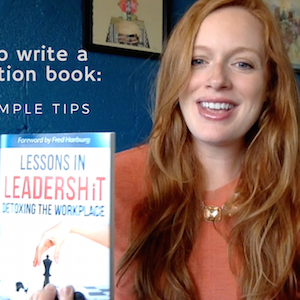
Writing a book is hard, but it’s a lot easier if you get a couple of things right from the beginning! Lessons in Leadershit by Ana Dutra is a great example of how an author set herself up for success early in the writing process.
Transcript:
Hi. This is Amelia Forczak from Pithy Wordsmithery. And today I want to talk about a book that came out recently, and a couple of things that it does particularly well, because I think that aspiring authors can learn from it. So the book is called Lessons in Leadershit, and it’s by Ana Dutra, who’s the president of the Executives Club of Chicago. So the first thing that the book does really well is come up with a concept that it’s perfect for branding. So leadership with the T we all know what leadership is. Leadership is kind of self explanatory. It’s funny, when Anna came to me with this idea, I was thinking, Gosh, this is, like the best idea, and it’s probably already taken, but it wasn’t so that’s like, half the challenge, right? Is coming up with a branded term that can be all your own. For nonfiction authors, it’s great because you can use it for speaking or workshops or consulting and sort of just like, sprinkle that in so that it’s like, it’s your brand, it’s your concept. People know, like, what you’re what you’re good at, like what all of your sort of like service offerings and expertise, like, what it’s all about. So for Ana, she’s got so much experience with leadership, and she also has a lot of experience with, like, how it breaks down. So that’s what this book is about. It’s got all the different sort of, like, bad leaders put into different character types. So that’s the other thing that the book does really well, is it’s super well organized. So Ana came up with different bad leaders, kind of like the poor, poor communicator, the manipulator, the tyrant, the land grabber, all these different types. And so when we were we were thinking about, okay, how do we put this book together? It’s like, if we put them into different chapters, it becomes super easy to figure out what you’re going to write about in that chapter, and almost more importantly, what you’re not going to write about. Because one of the hardest things when you’re writing a book isn’t just coming up with the the topic or coming up with like, the content for the chapter, but it’s staying on topic and not going off on a tangent and talking about something else that should really be in another part of the book. So, for example, when we’re talking about the manipulator, we’re not going to talk too much about poor communication, because that’s actually going in another chapter, like we can touch on it a little bit. But we know we have these boundaries so that can make it a lot easier to write a book. And it’s like, really one of the best gifts an author can give themselves is a really well organized table of contents. So you want it to have a good pacing, you want the flow to be good and you want the chapters to be in like pretty similar length. So that’s definitely something that this book does well. You can get it on Amazon. This is Amelia from Pithy Wordsmithery.
Get more posts like this one
Practical notes on ghostwriting, storytelling, and building an author platform — delivered straight to your inbox.
- New posts delivered to your inbox
- Behind-the-scenes on real book projects
- First access to workshops and courses
Book Cover Design – 5 Covers That Work and Why
People judge books by their covers. That’s why it’s worth the time for authors to learn a little about designing a book cover so they understand what works and why. In this video, I show five examples of awesome covers and share some tips for designing your own book cover. A few small changes could…
Read
How to write a non-fiction book: Three ways to leverage interviews
One of the biggest missed opportunities for aspiring authors is failing to leverage great interviews when writing a book. Instead of working in a vacuum, it’s so easy to step outside that and get the perfect material to take your project to the next level. Here are three ways interviewing people can be a godsend…
Read